A Study of Municipal Incorporation
for Niwot, Colorado
The Niwot Incorporation Committee is a resident-led effort to evaluate whether municipal incorporation would benefit our community. This site presents findings, schedules public meetings, and provides resources for informed participation. View documents.
Please bring a neighbor — this is a community conversation.
The Question Before Us
Niwot is a community of approximately 4,100 residents in Boulder County. Unlike nearly every Colorado community of comparable size, Niwot is not incorporated. Decisions about our roads, land use, building codes, and public safety are made by Boulder County Commissioners—officials Niwot residents cannot meaningfully influence, as we represent only 1.2% of the county's population.
Municipal incorporation would transfer certain local authorities from the county to a town government elected by and accountable to Niwot residents. This committee is studying whether such a transfer would serve the community's interests.
Why This Conversation Matters
Incorporation is one legal option that some residents believe could better align local decision-making with the people who live and work here.
This committee's role is to share information, publish preliminary findings, and host public meetings so residents can ask questions and help shape the path forward.
Present Circumstances
- County-maintained roads in Niwot continue to decline with no scheduled repairs
- Local businesses face higher operating costs than nearby incorporated towns
- County land-use rules limit property renewal and may affect home values
- Fire and EMS costs are significantly higher than comparable communities
- Public safety priorities are set at the county level
- No local authority over Niwot's long-term planning
What Incorporation Would Enable
- Local election of town leadership accountable to Niwot voters
- Authority over road maintenance, repair, and improvement
- Access to state and federal infrastructure grants
- Local land-use and building regulations
- Direct negotiation of service contracts for fire, EMS, and law enforcement
- Spending priorities determined by residents
"If we won't govern ourselves, others will—and not in our interest." — Niwot Incorporation Committee
Public Meetings
| Date | Thursday, January 22, 2026 |
| Time | 6:30 PM – 8:00 PM |
| Location | Rocky Mountain Christian Church 9447 Niwot Road, Niwot, CO 80503 |
Resources & Documents
Town Hall Presentation — December 9, 2025
Summary of findings and preliminary planning. Subject to refinement based on community input.
View Document (PDF)Colorado Local Government Handbook
Published by the Colorado General Assembly. Reference for municipal incorporation procedures.
View HandbookFire Protection & Emergency Medical Services
Fire & EMS Service Continuity: Whether Niwot could maintain continuous professional fire protection and ALS emergency medical service under an incorporated town government.
Governance & Cost Allocation: How governance structure affects cost responsibility, accountability, and long-term contracting options for fire and EMS.
These documents address fire protection and emergency medical services only. They are not a comprehensive incorporation feasibility study.
Frequently Asked Questions
What is incorporation?
Incorporation means Niwot becomes a Home Rule municipality with a locally elected government responsible for decisions that currently fall to Boulder County. As a Home Rule town, Niwot gains the authority to make decisions in key areas of daily life, including:
- Road repair and maintenance
- Snow removal through a negotiated contract
- Local zoning and land-use rules
- Building codes and permitting
- Downtown renewal and the business environment
- Events, parks, trails, and community investments
- Local minimum wage
- Short-term rentals and nuisance ordinances
- Sales-tax rates and local fee structures
- A negotiated contract directly with the Boulder County Sheriff for law enforcement and public safety
- Negotiated contracts for fire and emergency services
These are the areas where Niwot currently has no independent authority and relies entirely on decisions made by the County Commissioners — officials Niwot cannot elect.
Some services will continue to be provided by Boulder County:
- Public health and human services
- Elections administration
- Major regional transportation planning
- Recorder, Clerk, and Assessor functions (titles, deeds, property valuation)
- County courts and the judicial system
Incorporation doesn't replace the county — it simply gives Niwot control over the local decisions that shape our daily life, our infrastructure, and our future.
For more information about municipal incorporation in Colorado, see the Colorado Local Government Handbook published by the Colorado General Assembly.
Why isn't Boulder County enough?
Counties and municipalities serve different roles under Colorado law. Counties are designed to provide regional services — like courts, public health, and major transportation planning — across large geographic areas.
Towns and cities provide local services tailored to their communities — roads, land use, local policing priorities, and creating conditions that enable businesses to thrive. The state's structure assumes most communities will eventually incorporate as they grow, which is why almost every community of Niwot's size in Colorado is already incorporated.
Niwot is an outlier — not because we're too small or too rural, but because we haven't yet done what the state and county structure expects communities to do. Remaining unincorporated puts us at a structural disadvantage, competing with neighboring towns that have full local control while we depend entirely on county decisions made elsewhere.
Incorporation doesn't mean we're rejecting the county — it means we're filling the local governance role the system was designed for.
What area would be incorporated?
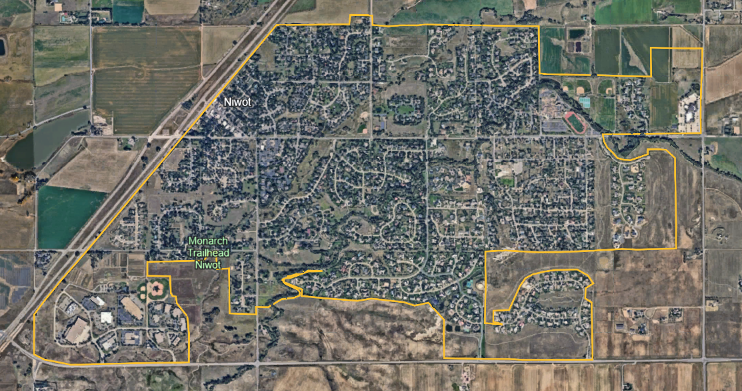
The proposed boundary encompasses the core Niwot community, including residential areas, the business district, schools, and community facilities. The map above shows the preliminary boundary, which follows natural and community boundaries.
The boundary will be finalized before the incorporation petition is submitted, based on community input and practical considerations.
Who will be responsible for making decisions?
Incorporation puts Niwot's future in the hands of Niwot voters. The process works in three steps:
1. Voters elect a Charter Commission.
This group is made up of Niwot residents chosen directly by voters. Their job is to study options and draft a proposed Town Charter — essentially Niwot's local constitution.
2. Voters approve the charter — through a two-vote process.
Once the Charter Commission completes its work, the proposed charter goes to an election.
- If voters approve it on the first vote: Niwot becomes a Home Rule municipality.
- If voters reject it on the first vote: the charter goes back to the Charter Commission for revision.
- If voters reject it a second time: the process stops and Niwot does not incorporate.
No town is created unless a majority of Niwot voters approve the charter.
3. Voters elect the first town leadership.
If the charter passes, voters elect the town officials defined in the charter — typically a mayor and council. The council then hires a professional town manager to run day-to-day operations.
Once elected, these officials are directly accountable to Niwot voters and responsible for decisions that currently fall to Boulder County.
From that point forward, key local decisions are made by the people who live here and answer to Niwot voters — not to voters in Boulder, Longmont, or other cities.
Will my vote matter more?
Yes. Today, Niwot has almost no influence over the County Commissioners who make decisions about our roads, our land use, and our daily life. With only 4,100 residents, our votes are drowned out by Boulder, Longmont, Louisville, Lafayette, Erie, and Superior.
Incorporation changes that.
As a town, we elect our own leaders — people who live here, know this place, and answer directly to Niwotians, not to voters in other cities.
Your vote would finally shape Niwot's future.
Your voice would finally matter.
What happens to our roads?
If Niwot incorporates, we can finally take responsibility for our own roads instead of waiting on Boulder County. As a town, we will be able to:
- Prioritize repairs immediately
- Apply for state and federal grants that unincorporated communities cannot access today
- Hire contractors who work affordably and on schedule
Our current plan is to dedicate about $1.5 million per year to roads. The approach is straightforward:
- Develop a comprehensive road repair plan and cost estimate
- Choose the most efficient financing tool — either a voter-approved road bond or revenue-backed financing
- Use the dedicated $1.5M annual budget to repay that financing
- Reduce long-term costs once the backlog of deferred maintenance is cleared
Across Colorado, small towns rely on grants to repave streets, improve drainage, and upgrade sidewalks. Incorporation allows Niwot to do the same and significantly reduce the burden on local taxpayers.
Bottom line: incorporation gives Niwot the authority and funding tools to fix our roads properly — and keep them that way.
Will our town be safer?
Yes. Incorporation gives Niwot direct control over law-enforcement priorities for the first time. Today, Niwot is simply one small part of the county's jurisdiction, and we have no say in staffing levels, patrol patterns, or response expectations.
As a town, we will contract directly with the Boulder County Sheriff through a service-level agreement — just like other municipalities do. This allows Niwot to:
- Set our own safety priorities
- Specify the level of patrol coverage we want
- Improve response times for homes, businesses, and the schools
- Ensure officers focus on Niwot's needs, not countywide demands
- Coordinate directly with command staff through designated liaisons
- Address issues quickly because decisions are made locally
The Sheriff's Office will still provide the personnel — incorporation simply lets Niwot define the level of service, focus, and presence we expect.
Bottom line:
A direct contract means Niwot finally has a say in its own safety, leading to faster response times and a more consistent presence in the community.
What happens with land use?
Under Home Rule, Niwot sets its own land-use rules — shaped by residents and adopted by a locally elected town government. This means decisions about zoning, building size, remodel requirements, downtown renewal, and future growth are made here, not by officials in Boulder who Niwot cannot elect.
Have you ever met a Niwotian who doesn't love our semi-rural character, the open spaces that surround us, and our small, walkable downtown? Incorporation allows us to preserve this identity while still supporting thoughtful, community-guided renewal of older homes and businesses.
As a town, Niwot will be able to:
- Maintain our semi-rural, low-density character
- Protect the open spaces and buffers that define Niwot
- Set local zoning and building rules that fit our values
- Update out-of-date regulations that currently make improvement and remodels harder than they need to be
- Support sensible renewal of aging properties while keeping Niwot's charm intact
- Guide the future of downtown with input from residents and business owners
In short: land-use decisions will finally be made by the people who know and love Niwot best — Niwotians.
Will my taxes go up?
We are still finalizing our plan, but here's what we expect today:
For most homeowners, we expect a net decrease.
Once Niwot can renegotiate its fire and emergency service costs, property taxes should go down — this is the largest source of savings. There will be a modest increase in sales tax, but for most homeowners the property-tax reduction should outweigh it.
For renters, the outcome depends on your landlord.
If your landlord passes along the property-tax savings, you should also see a net decrease. If not, your main change will be the modest sales-tax increase, which may result in a small net increase depending on your local/online spending.
During the transition period — before fire and EMS contracts are renegotiated — there will be a temporary increase.
We are still evaluating the precise structure and timing of this phase.
Our goal is simple:
Keep taxes low, fix what's broken, and give Niwot control over its own costs. We want Niwot to remain competitive for businesses, maintain a noticeably lower sales tax than neighboring municipalities, and keep property taxes aligned with the region.
Why is fire protection funding a key issue in the incorporation discussion?
In short: Incorporation allows Niwot to contract for fire services based on service cost rather than assessed value, which may reduce the current imbalance.
Related Documents (Fire & EMS Only):
- Fire & EMS Service Continuity — explains how continuous professional fire + ALS EMS service can be maintained if Niwot incorporates.
- Governance & Cost Allocation — explains why costs are structurally high and what contracting options exist under municipal governance.
This is one of the most common and important questions we receive.
The short answer is that incorporation gives Niwot both the authority and the responsibility to ensure that essential services — including fire protection — are funded in a way that is fair, proportional, and aligned with actual service costs. Under the current system, Niwot is not paying a fair price.
Under existing arrangements, Niwot pays approximately $3.6 million per year for fire services. Niwot has roughly 4,100 residents, covers about 4 square miles, and is served by one fire station.
For comparison, the Lyons Fire District:
- Serves approximately 6,200 residents
- Covers roughly 66 square miles
- Operates two fire stations
- Has an annual fire budget of approximately $2.8 million
The issue is not the quality of fire service, nor is it a critique of firefighters. The issue is structural.
Fire districts are funded by mill levy, which ties cost to assessed property value, not to population, geography, infrastructure, or service demand. Because Niwot's property values are significantly higher than much of the Mountain View Fire District, Niwot contributes a disproportionately large share of total district revenue relative to the actual scope of service required.
From a governance perspective, this creates a stewardship problem.
If incorporation is fundamentally about better stewardship of existing resources — fire protection, roads, and town services — then it would be irresponsible not to question a system in which a small, compact town with modest service needs is paying nearly double what comparable communities pay on a service-cost basis. Continuing the status quo without challenge would itself be a failure of stewardship.
Incorporation gives Niwot the legal authority to address this imbalance.
Colorado law explicitly grants municipalities authority over public safety services, including fire protection, and allows them to contract for those services through intergovernmental agreements:
- CRS §31-15-401(1) — Municipal authority over public safety and contracting
- CRS §29-1-203 — Authorization for intergovernmental agreements (IGAs)
Upon incorporation, Niwot would be legally empowered to:
- Negotiate a service-based contract for fire protection,
- Contract with another provider, or
- Ultimately operate a municipal fire department.
This is not an unusual or untested model. Many municipalities across Colorado fund fire protection through their general budgets rather than through a separate fire district.
Of course, the incorporation committee is open to good-faith conversations with the Mountain View Fire District, and a positive outcome would be to retain their services under a fair, service-based agreement. Nothing in the incorporation plan assumes conflict as the desired result. At the same time, it is important to be clear about process: until Niwot is formally incorporated, it has no legal standing to negotiate, contract, or commit to post-incorporation fire service terms. Any detailed negotiations prior to incorporation would be non-binding and potentially misleading. The appropriate and standard sequence is to incorporate first, then formally engage service providers as a municipal entity with authority to act.
For additional context, it is also useful to look at total mill levy in nearby incorporated communities:
- Boulder: ~89 mills, no fire district
- Longmont: ~97 mills, no fire district
- Erie: ~116 mills, with fire district
- Lyons: ~128 mills, with fire district
Communities without fire districts often achieve lower total tax burdens and better alignment between service cost and local priorities by funding fire services municipally rather than through a separate taxing district.
Fire service savings are not the sole source of revenue for a future Town of Niwot, but they are material. The difference between mill-levy funding and service-cost-based funding is large enough to meaningfully offset the cost of operating a small municipal government. Those savings would be reinvested locally — into fire protection, roads, and core town services — under accountable local governance.
The incorporation committee's position is straightforward: Niwot should be governed in a way that responsibly stewards its existing resources for the benefit of the people who live here. When existing arrangements no longer reflect fairness, proportionality, or responsible use of taxpayer dollars, change is not just permitted — it is required.
Incorporation provides the lawful, transparent mechanism to make that change.
Will incorporation change Niwot's identity?
Incorporation protects Niwot's identity — it doesn't replace it.
Today, Niwot competes with surrounding towns that have full control over their roads, business environment, land use, and local investment. Remaining unincorporated leaves us increasingly vulnerable to decisions made in Boulder, Longmont, and other cities that do not share our priorities. Incorporation gives Niwot the ability to stay competitive, protect property values, and preserve the unique character people move here for.
Niwot also has a deep culture of volunteerism — our concerts, festivals, parades, markets, and traditions are run by local champions who pour their hearts into this town. That will not change. Incorporation will not mean the town government "runs" our events. The spirit of Niwot comes from Niwotians, and it always will.
What incorporation does allow is continuity and stability:
- The current LID generates roughly $250,000 per year for events, marketing, economic development, and small infrastructure improvements.
- As a town, we plan to maintain a similar (or stronger) dedicated fund.
- Funding decisions will continue to be made by a resident-led group, just as they are today.
- The events themselves will continue to be run by volunteers, businesses, and the community — not by Town Hall.
In short:
Incorporation gives Niwot control over land use, safety, and infrastructure — the things that protect our charm and competitiveness — while preserving what makes Niwot Niwot: a strong community, a volunteer spirit, and events run by the people who love this place.
In the News
The Left Hand Valley Courier has published an ongoing series on the incorporation initiative.
- Interest in incorporating Niwot rekindled — Nov 26, 2025
- Incorporating Niwot is a multi-step process — Dec 3, 2025
- Proposed town of Niwot boundaries considered — Dec 10, 2025
- Niwot town hall explores details of possible incorporation — Dec 17, 2025
- Revenue sources for Niwot as an incorporated city — Dec 24, 2025
- Projected expenses for an incorporated Niwot — Jan 7, 2026
- Road paving under a Public Improvement District vs. an incorporated Niwot — Jan 14, 2026
Receive Updates
Provide your information to receive notices of public meetings and committee findings.