A Study of Municipal Incorporation
for Niwot, Colorado
The Niwot Incorporation Committee is a resident-led effort studying municipal incorporation for Niwot, Colorado. This site presents findings, schedules public meetings, and provides resources for informed participation. View documents.
Last updated: March 5, 2026
6:30 PM · Niwot Hall
The Question Before Us
Niwot is a community of approximately 4,300 residents in Boulder County. Unlike most Colorado communities of comparable size, Niwot is not incorporated. Decisions about our roads, land use, building codes, and public safety are made by Boulder County Commissioners—officials elected by the full Boulder County electorate, where Niwot represents approximately 1.3% of voters.
Municipal incorporation would create a local government elected by and accountable to Niwot residents, with authority over the local decisions that shape daily life here.
Incorporation is fundamentally about aligning local responsibility with local authority.
- Establishes the Town of Niwot as a Home Rule municipality, with the charter drafted afterward by an elected charter commission and then approved by Niwot voters
- Gives the town authority over roads, land use, and local services
- Funds core services through a 2.5% sales tax and 4-mill property tax
- Repairs roads using a voter-approved revenue-backed bond
- Leaves county services (courts, public health, elections) unchanged
- Niwot voters elect their own town council
- Road repair priorities are set locally
- Land-use decisions move from Boulder County to Niwot
- Police service is contracted directly with the Sheriff
- County services like courts, health, and elections remain unchanged
Niwot has operated as an unincorporated community for many years, and for much of that time the existing governance structure worked reasonably well.
In recent years, however, several developments have highlighted the limits of that structure:
- Road maintenance responsibilities remain unresolved
- County-wide land-use and building regulations — including home size and construction requirements — are written for the broader Boulder County context and applied equally to Niwot despite the town's different scale and character
- Utility outages highlight the lack of local franchise authority
- County-level policies such as minimum wage directly affect local businesses — Boulder County's recent minimum wage policy required extensive advocacy from Niwot residents and business owners to address impacts unique to the town's small-scale economy
These experiences have prompted a broader discussion about whether Niwot would benefit from having municipal authority over certain local decisions — particularly roads, land use, local business conditions, and other policies that directly affect daily life in town.
The proposal being evaluated is incorporation as a Home Rule municipality. Under Colorado's Home Rule process, the town charter would be drafted by an elected charter commission and then submitted to voters for approval.
How Niwot Is Governed Today
- Road priorities are determined by Boulder County, which maintains all public roads in Niwot
- Land-use and building-code decisions are made by county officials Niwot residents do not elect
- Law-enforcement coverage is provided through county-wide sheriff staffing rather than through a locally directed contract
- Local businesses operate under county rules that differ from those in nearby incorporated towns
- Utility franchise agreements with companies like Xcel Energy are negotiated by Boulder County rather than by a local government representing Niwot. As a result, Niwot residents and businesses have no direct mechanism to require service standards, infrastructure investment, or accountability when outages occur.
- Niwot has no independent authority over long-term planning or capital investment
What Incorporation Would Change
Today
With Incorporation
- Local election of town leadership accountable to Niwot voters
- Authority over road maintenance, repair, and improvement
- Access to state and federal infrastructure grants
- Local land-use and building regulations
- Direct contracting for law enforcement through a service-level agreement with the Sheriff
- Franchise agreements with utilities, allowing Niwot to negotiate service reliability standards, outage communication, and infrastructure investment
- Spending priorities determined by residents
Today, Boulder County determines the timing and priority of Niwot road repairs. Under incorporation:
- Niwot controls local road maintenance and sets repair priorities
- Approximately $1.8 million per year dedicated to roads, including bond repayment and ongoing maintenance
- Road priorities determined locally rather than competing with the rest of Boulder County
- Repairs accelerated through a voter-approved revenue-backed road bond repaid from the town's sales-tax revenue rather than a new property-tax increase
What Incorporation Does Not Change
- County services—public health, courts, elections, regional transportation—continue as before
- Special district taxes (water, sanitation, fire) are unaffected by incorporation
- St. Vrain Valley schools remain unchanged
- Niwot’s semi-rural character and open-space buffers remain intact
- LID services and functions continue — administered locally under the town council
- HOA covenants and private community rules are unchanged
Incorporation does not create a large bureaucracy.
Incorporation does not automatically change zoning, annex land, or approve development. Those decisions would remain subject to public processes and voter-elected leadership.
Many Niwot residents express a strong desire to preserve the town's small-scale character. Incorporation simply allows those decisions to be made locally rather than by Boulder County.
Any long-term governance rules would be written by a locally elected Charter Commission and must be approved by Niwot voters.
The Community Decision Process
Incorporation is not a decision made by a committee. It is a multi-step process controlled by Niwot voters at every stage:
- Petition. Residents sign a petition to place the question of incorporation on the ballot.
- Incorporation Vote. Niwot voters decide whether to incorporate as a Home Rule municipality.
- Charter Commission Election. If incorporation passes, voters elect a Charter Commission of Niwot residents to draft a proposed town charter.
- Charter Vote. Voters approve or reject the proposed charter. If rejected, the commission revises and voters vote again. If rejected a second time, the process stops.
- Town Leadership Election. If the charter passes, voters elect the first mayor and town council.
No charter exists yet; it would be written by residents elected by Niwot voters after incorporation passes.
This committee’s role is informational—to research, publish findings, and host public meetings so residents can make an informed decision.
Public Meetings
| Date | Thursday, March 12 |
| Time | 6:30 PM |
| Location | Niwot Hall |
| Format | Moderated Q&A — residents may submit questions during the session |
Written questions may also be submitted at any time to contact@niwot.town.
| Date | Friday, March 27 |
| Time | 9:30 AM |
| Location | TBD |
| Date | Tuesday, April 14 |
| Time | 6:30 PM |
| Location | Niwot Hall |
Public Notices
Budget Workshop Materials Posted + Committee Statement Published
Financial models, presentation materials, consolidated notes & open questions, and the Committee’s formal statement on the structural reasoning behind incorporation are now available for public review.
Read NoticePost Town Hall Strategy Update
Follow-up to the January town halls covering next steps, ongoing research, and newly published background materials.
Read NoticeResources & Documents
Tax Estimate Calculator
Estimate your annual cost under the proposed 2.5% sales tax and 4-mill property tax levy. Enter your home value and spending to see a personalized estimate.
Open CalculatorRecognizable to Itself
A reflection on community scale, civic responsibility, and why Niwot may benefit from aligning authority with local stewardship.
Read EssayPro Forma Budget & Financial Assumptions
14-year revenue and expense projections, detailed assumptions, sensitivity analysis, and Monte Carlo stress testing for an incorporated Town of Niwot. Roads are modeled with a voter-approved, revenue-backed bond repaid from Niwot's local sales-tax revenue.
View Pro FormaBudget & Financial Review Workshop — February 27, 2026
Consolidated notes, open questions, and presentation slides from the budget and financial review public workshop.
Town Hall Presentation No. 2 — January 22, 2026
Updated findings, budget details, and community Q&A responses. Subject to refinement based on community input.
Town Hall Presentation No. 1 — December 9, 2025
Summary of findings and preliminary planning. Subject to refinement based on community input.
View Document (PDF)Colorado Local Government Handbook
Published by the Colorado General Assembly. Reference for municipal incorporation procedures.
View HandbookFire Protection Services
Background on fire protection in Niwot, including current structure, cost analysis, and potential options under incorporation.
View Fire Services OverviewFrequently Asked Questions
What is the committee’s high-level reasoning for considering incorporation?
Niwot’s character is strong—but character alone does not protect a community over time. Structure does. When decisions about roads, land use, and public safety are made at a scale where Niwot represents roughly 1–2% of the electorate, outcomes gradually reflect broader priorities rather than local ones. That drift is not dramatic, but it compounds.
Incorporation would align authority with responsibility—placing primary discretion over Niwot’s future in the hands of the people who live with the consequences. The goal is continuity, not reinvention.
We published a longer statement exploring this reasoning in detail: Recognizable to Itself.
What is incorporation?
Incorporation means forming a municipality with its own locally elected government. The proposal being studied for Niwot would establish the Town of Niwot as a Home Rule municipality under the Colorado Constitution.
Under the proposed process, Niwot voters would first decide whether to incorporate as a Home Rule municipality. If the measure passes, residents then elect a charter commission that drafts the town's governing charter. The proposed charter is returned to voters for approval before the permanent town government takes office.
As a Home Rule town, Niwot would gain the authority to make decisions in key areas of daily life, including:
- Road repair and maintenance
- Snow removal through a negotiated contract
- Local zoning and land-use rules
- Building codes and permitting
- Downtown renewal and the business environment
- Events, parks, trails, and community investments
- Local minimum wage
- Short-term rentals and nuisance ordinances
- Sales-tax rates and local fee structures
- A negotiated contract directly with the Boulder County Sheriff for law enforcement and public safety
- Negotiated contracts for fire and emergency services
These are the areas where Niwot currently has no independent authority and relies entirely on decisions made by the County Commissioners — officials Niwot cannot elect.
Some services will continue to be provided by Boulder County:
- Public health and human services
- Elections administration
- Major regional transportation planning
- Recorder, Clerk, and Assessor functions (titles, deeds, property valuation)
- County courts and the judicial system
Incorporation doesn't replace the county — it simply gives Niwot control over the local decisions that shape our daily life, our infrastructure, and our future.
For more information about municipal incorporation in Colorado, see the Colorado Local Government Handbook published by the Colorado General Assembly.
Why isn't Boulder County enough?
Counties and municipalities serve different roles under Colorado law. Counties are designed to provide regional services — like courts, public health, and major transportation planning — across large geographic areas.
Towns and cities provide local services tailored to their communities — roads, land use, local policing priorities, and creating conditions that enable businesses to thrive. Colorado's system gives communities the option to incorporate when they determine that local decisions should be made locally. That is why almost every community of Niwot's size already has municipal government.
Niwot is an outlier — not because we're too small or too rural, but because we haven't yet done what the state and county structure expects communities to do. Remaining unincorporated means Niwot relies entirely on county decisions rather than having local authority, while neighboring towns that have incorporated control their own roads, land use, and services.
Incorporation doesn't mean we're rejecting the county — it means we're filling the local governance role the system was designed for.
How does the question of incorporation get on the ballot?
Under Colorado law, incorporation begins with the formation of an incorporation committee. The committee prepares a petition and gathers signatures from eligible voters who live within the proposed town boundaries. Once the required number of signatures is collected and verified by Boulder County, the question of incorporation is placed on the ballot for a vote.
Who votes on whether Niwot incorporates?
Only registered voters who live within the proposed Town of Niwot boundaries vote on the incorporation question. Voters elsewhere in Boulder County do not vote on whether Niwot incorporates.
What area would be incorporated?
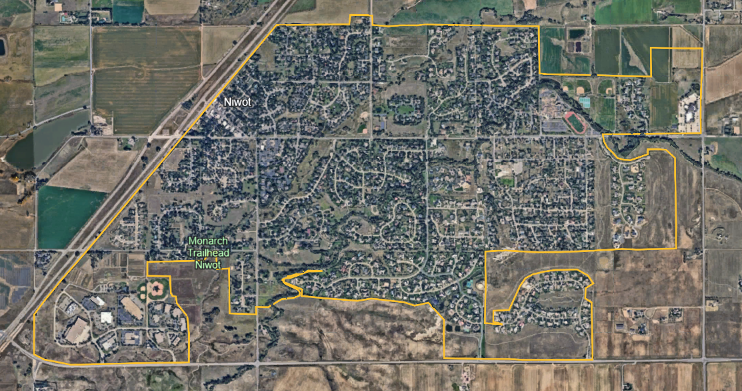
The proposed boundary encompasses the core Niwot community, including residential areas, the business district, schools, and community facilities. The map above shows the preliminary boundary, which follows natural and community boundaries.
The boundary will be finalized before the incorporation petition is submitted, based on community input and practical considerations.
Who will be responsible for making decisions?
Incorporation puts Niwot's future in the hands of Niwot voters. The process works in five steps:
- Petition. Residents sign to place the incorporation question on the ballot.
- Incorporation Vote. Niwot voters decide whether to incorporate as a Home Rule municipality.
- Charter Commission Election. If incorporation passes, voters elect a Charter Commission to draft the town charter.
- Charter Vote. Voters approve or reject the proposed charter. If rejected, it is revised and voted on again. If rejected twice, the process stops.
- Town Leadership Election. If the charter passes, voters elect the first mayor and council.
No charter exists yet; it would be written by residents elected by Niwot voters after incorporation passes.
Once elected, town officials are directly accountable to Niwot voters and responsible for decisions that currently fall to Boulder County. The council then hires a professional town manager to run day-to-day operations.
Does incorporation add another layer of bureaucracy?
No. Incorporation doesn't add bureaucracy so much as it moves decision-making closer to the people who live with the consequences.
Today, Niwot already operates under a significant bureaucratic system. Permits, land-use decisions, enforcement priorities, road maintenance, and service levels are handled through Boulder County departments. That bureaucracy exists today and applies to Niwot residents and businesses.
What incorporation changes is accountability. Instead of decisions being made by county departments that ultimately answer to county commissioners—officials Niwot residents cannot meaningfully influence—incorporation places local decisions under a town government elected by and accountable to Niwot voters.
Incorporation is therefore less about creating "more government" and more about local control and responsiveness.
In practice, incorporation can mean:
- Local priorities set by officials who live in Niwot
- Faster feedback and clearer accountability when problems arise
- Rules and processes tailored to a small town, rather than county-wide systems designed for much larger and more diverse areas
It does not require:
- Creating a large municipal bureaucracy
- Duplicating county departments
- Adding unnecessary layers of administration
Most small towns operate with lean staff and rely heavily on contracts and shared services, keeping government efficient while making it more accountable to residents.
Will my vote matter more?
Yes. Incorporation changes the electorate for local decisions from the full county to Niwot voters. Town officials would be elected only by registered voters within the Town of Niwot boundaries.
Today, decisions about Niwot's roads, land use, and services are made by county officials elected by the full Boulder County electorate, where Niwot represents approximately 1.3% of voters. As an incorporated town, those decisions would be made by leaders elected by and accountable to Niwot residents.
What happens to our roads?
Roads are the most visible infrastructure challenge in Niwot. Today, Boulder County maintains Niwot's public roads and determines the timing and priority of repairs.
If Niwot incorporates, the Town would assume responsibility for local roads and implement a dedicated funding plan.
Our current financial model dedicates approximately $1.8 million per year to roads. Rather than spreading repairs across decades, the Town would ask voters to approve a revenue-backed road bond — fixing roads as fast as possible while repaying the bond gradually from sales-tax revenue.
This bond would be repaid from Niwot's local sales-tax revenue — not from an additional property-tax increase.
Because the bond would be backed by sales-tax revenue rather than property taxes, homeowners would not see an additional property-tax increase tied to the road program.
This approach allows Niwot to:
- Repair roads sooner instead of spreading work across decades
- Repay the bond gradually from existing town revenue
- Keep property taxes low while still fixing infrastructure
- Maintain a stable annual road maintenance program once the backlog is cleared
Municipalities across Colorado commonly use revenue-backed bonds to address infrastructure backlogs while keeping annual costs predictable.
Bottom line: incorporation gives Niwot the authority and financial tools to fix our roads properly — and keep them that way.
What does "revenue-backed bond" mean?
A revenue-backed bond is repaid from a specific revenue stream — in this case, Niwot's local sales-tax revenue — rather than from a property-tax pledge. The purpose is to accelerate road repairs while keeping annual funding predictable.
Will our town be safer?
Incorporation would give Niwot direct control over law-enforcement priorities. Today, Niwot is simply one small part of the county's jurisdiction, with limited say in staffing levels, patrol patterns, or response expectations.
As a town, we will contract directly with the Boulder County Sheriff through a service-level agreement — just like other municipalities do. This allows Niwot to:
- Set our own safety priorities
- Specify the level of patrol coverage we want
- Improve patrol presence and accountability for response performance
- Ensure officers focus on Niwot's needs, not countywide demands
- Coordinate directly with command staff through designated liaisons
- Address issues quickly because decisions are made locally
The Sheriff's Office will still provide the personnel — incorporation simply lets Niwot define the level of service, focus, and presence we expect.
Bottom line:
A direct contract means Niwot has a say in its own safety, allowing the town to define patrol coverage goals, service expectations, and a more consistent local focus.
What happens with land use?
Under Home Rule, Niwot sets its own land-use rules — shaped by residents and adopted by a locally elected town government. This means decisions about zoning, building size, remodel requirements, downtown renewal, and future growth are made here, not by officials Niwot residents cannot meaningfully influence the election of.
Any annexation of surrounding land would require approval by the Town government and would occur through a public process subject to local political accountability. Annexation in Colorado also requires landowner consent and is subject to state statutory procedures. Annexation proposals would also be subject to public hearings and decisions by officials elected by Niwot voters. Long-term annexation policy could also be limited or defined in the town charter drafted by the elected Charter Commission and approved by Niwot voters.
Niwot residents consistently express a desire to preserve our semi-rural character, the open spaces that surround us, and our small, walkable downtown. Incorporation allows us to preserve this identity while still supporting thoughtful, community-guided renewal of older homes and businesses.
As a town, Niwot will be able to:
- Maintain our semi-rural, low-density character
- Protect the open spaces and buffers that define Niwot
- Set local zoning and building rules that fit our values
- Update out-of-date regulations that currently make improvement and remodels harder than they need to be
- Support sensible renewal of aging properties while keeping Niwot's charm intact
- Guide the future of downtown with input from residents and business owners
In short: land-use decisions will be made locally by officials elected by Niwot residents.
Will my taxes go up?
The proposed tax plan is a 2.5% local sales tax and a 4-mill property tax levy.
Incorporation would introduce a municipal sales tax and a road bond repayment supported by that tax. These are not hidden costs — they are the mechanism by which the community funds roads and municipal services currently controlled by the county.
Any future tax increases would require approval from Niwot voters under Colorado's Taxpayer Bill of Rights (TABOR).
Road financing: the road bond concept is a revenue-backed bond repaid from the town's sales-tax revenue (not a new property-tax increase tied to the bond).
For most homeowners, the proposed tax package is modest and competitive with nearby towns.
The 4-mill levy is comparable to or below what nearby incorporated towns charge. The 2.5% sales tax is lower than Boulder, Longmont, Louisville, and most Front Range municipalities. Combined, the plan funds core town services—roads, land use, administration, and public safety contracting—without relying on aggressive tax rates.
For renters, the primary change is the sales tax. Whether you also benefit from property-tax dynamics depends on whether landlords pass through any adjustments.
What about fire?
We believe there is a potential opportunity to reduce fire and EMS costs through renegotiated service contracts once Niwot has municipal authority. We have published detailed analysis supporting that view. However, we have deliberately deferred action on fire to the post-incorporation period—it requires the legal standing that only a municipal government provides. Any savings from fire restructuring would come on top of the base tax plan described above.
Estimates are illustrative and depend on individual spending patterns, exemptions, and future adopted rates.
Estimate Your Cost
*Taxed at Colorado's 6.7% residential assessment rate × the proposed 4-mill levy.
**Excludes groceries, which are exempt from the sales tax.
***Includes remote and online retail purchases, streaming services, cell phone plans, and other taxable digital goods.
Our goal:
Fund local services at competitive rates, maintain a sales tax noticeably below neighboring towns, and position Niwot to capture additional savings—particularly in fire—once incorporation provides the authority to act.
How would fire protection work if Niwot incorporated?
Fire protection is currently provided by the Mountain View Fire Protection District, an independent special district.
Incorporation would not automatically change fire services. The town would have the ability to evaluate service arrangements and negotiate contracts if the community chose to pursue that in the future.
Fire protection will continue uninterrupted under the current district unless and until Niwot voters decide otherwise. Any fire service arrangement would be negotiated after incorporation, as required by Colorado law.
A detailed analysis of current costs and potential service structures is available on the dedicated fire services page.
View Fire Services AnalysisWill incorporation change Niwot's identity?
Incorporation protects Niwot's identity — it doesn't replace it.
Today, Niwot competes with surrounding towns that have full control over their roads, business environment, land use, and local investment. Remaining unincorporated leaves us increasingly vulnerable to decisions made in Boulder, Longmont, and other cities that do not share our priorities. Incorporation gives Niwot the ability to stay competitive, protect property values, and preserve the unique character people move here for.
Niwot also has a deep culture of volunteerism — our concerts, festivals, parades, markets, and traditions are run by local champions who pour their hearts into this town. That will not change. Incorporation will not mean the town government "runs" our events. The spirit of Niwot comes from Niwotians, and it always will.
What incorporation does allow is continuity and stability:
- The current LID generates roughly $250,000 per year for events, marketing, economic development, and small infrastructure improvements.
- As a town, we plan to maintain a similar (or stronger) dedicated fund.
- Funding decisions will continue to be made by a resident-led group, just as they are today.
- The events themselves will continue to be run by volunteers, businesses, and the community — not by Town Hall.
In short:
Incorporation gives Niwot control over land use, safety, and infrastructure — the things that protect our charm and competitiveness — while preserving what makes Niwot Niwot: a strong community, a volunteer spirit, and events run by the people who love this place.
In the News
The Left Hand Valley Courier has published an ongoing series on the incorporation initiative.
- Interest in incorporating Niwot rekindled — Nov 26, 2025
- Incorporating Niwot is a multi-step process — Dec 3, 2025
- Proposed town of Niwot boundaries considered — Dec 10, 2025
- Niwot town hall explores details of possible incorporation — Dec 17, 2025
- Revenue sources for Niwot as an incorporated city — Dec 24, 2025
- Projected expenses for an incorporated Niwot — Jan 7, 2026
- Road paving under a Public Improvement District vs. an incorporated Niwot — Jan 14, 2026
- Niwot residents share views on potential incorporation — Jan 21, 2026
- Niwot incorporation debate draws hundreds to second town hall — Jan 28, 2026
- Disputes with county help drive Niwot incorporation push — Jan 28, 2026
- Fire and EMS protection options under proposed Niwot incorporation — Feb 4, 2026
- Niwot incorporation plan projects $150,000 in incorporation costs — Feb 18, 2026
- Niwot incorporation proposal revised to exclude fire protection — Feb 25, 2026
- Niwot Incorporation Committee hosts budget workshop — Mar 4, 2026
- Grassroots group seeks to make Niwot Boulder County’s newest town — Daily Camera, Feb 15, 2026
Receive Updates
Provide your information to receive notices of public meetings and committee findings.
Committee Members & Community Contributors
This effort is led by a formal incorporation committee and supported by a growing group of community volunteers contributing time, expertise, and local knowledge.
Formal leadership of the Niwot Incorporation Committee
- Nick Little — President
- Steve Lehan — Secretary
- Paula Hemenway — Treasurer
- Deborah Fowler — Community Engagement Lead
Volunteers supporting research, outreach, and public engagement
- Adam Monette
- Amy Grolnick
- Andrew Fowler
- Biff Warren
- Colin Stewart
- Cornelia Sawle
- David Kates
- Dayna Roane
- Frank Farrall
- Georgianna Holderbein
- Heidi Storz
- Jim Parys
- Jim Ringel
- Joanna Parys
- Keith Nichols
- Kevin Klau
- Louis Hernandez
- Melissa Koller
- Mike Keffeler
- Orin Hargraves
- Paula Dicharry
- Sara Hughes
- Susan Biehl
- Suze Fischer
- Tim Conarro
- Tony Santelli
- Tracey Nichols
This effort is funded by Niwot residents and local business owners. We are not funded by any development company, political party, or outside organization.
Support is in the form of loans and donations to the Niwot Incorporation Committee, a 501(c)(3) nonprofit corporation. All contributions are in the range of $1,000 to $20,000. Some are pledges that will be fulfilled when the funds are needed.
As of January 31, 2026, approximately $150,000 has been raised.
Niwot Residents
- Marc & Barbara Arnold
- Ron & Grace Budacz
- Jim & Susan Cloar
- Andrew & Judy Cousin
- Andrew & Deborah Fowler
- Jon & Maria Gillespie-Brown
- Andrew & Amy Grolnick
- Jim & Paula Hemenway
- David & Georgianna Holderbein
- Kevin & Erin Klau
- Tim & Melissa Koller
- Steve & Lisbeth Lehan
- Nicholas & Sarie Little
- James & Megan Macintosh
- Matthew Neagle
- Keith & Tracey Nichols
- Steve & Lynda Pasma
- John & Susan Rademacher
- Tony & Felicia Santelli
- Heidi Storz
- Bruce & Susan Warren
Niwot Business Owners
- Alex Chlebek
- Deborah Fowler
- Nicholas Little
- Bruce "Biff" Warren