Roads in Niwot — Facts, Options, and Answers
May 8, 2026
Niwot has 31 miles of roads. 23 of them have no funded plan for repair. Every year of delay raises the cost. Two choices are actually available — and only one solves it for the whole community.
- 31 miles of roads in the proposed town. The county now plans to repair only 5 miles of main arteries; 23 miles have no funded repair plan.
- Average PCI of 44 across the 23 unfunded miles — well below every comparable Colorado municipality.
- Two choices are available: the Town plan on the November 3 ballot ($2.7M/yr, largely sales-tax backed), or a district for your own neighborhood, available today (14–47 mills, typically 33, property tax only). A townwide PID is not on offer: no proposal exists and nobody is assembling one, and it has been put to this community twice — defeated at the ballot in 2013 (county Issue 5C) and withdrawn before the ballot in 2025.
- A road district costs a typical home about three times what incorporation does. A townwide district’s 18 mills holds only while everyone stays in. Draw out those a district would tax for roads it never touches or roads they already pay for and it is about 27 mills; let every neighborhood cheaper on its own weigh in and it settles near 31 — $2,160 a year on the median home, against $752 for incorporation, and pavement only. Why a townwide PID isn’t an option.
- The longer the wait, the higher the cost. Repair triples or quadruples as PCI drops below 50, then below 25.
- Sellers may have to disclose it. Colorado requires sellers to disclose known material adverse facts — and the absence of a road-repair plan for these 23 miles can qualify.
Facts to Agree Upon
- The proposed town has 31 miles of roads. Less than 3 miles are privately owned. Boulder County abandoned 20 miles of roads in 1996 and said in 2025 it is abandoning another 3 miles of “residential collector” roads, now repairing only 5 miles of main arteries. The average PCI of the 23 miles of road that no one repairs is 44, well below any responsible community standard. Costs increase dramatically over time as road conditions fall below the threshold for chip or slurry seal. Some roads are unsafe and need immediate repair.
- Full-depth reclamation (FDR) and mill & overlay (M&O) are preferred repair methods and are used by major road contractors throughout Colorado. PCI thresholds for each method will be finalized in the project engineering phase. FDR is cost-effective, environmentally preferred, reduces exposure to oil-price volatility, and greatly reduces full-depth repair time compared to traditional remove-and-replace (R&R) reconstruction.
- Boulder County sets PID mill levies from a conservative cost per mile for full depth reconstruction. That figure is what the County uses regardless of which reconstruction method is ultimately bid — reclamation or remove-and-replace — and the County has affirmed those costs in general terms. A specific PID would be sized from a more detailed analysis of the area.
- The 2025 community-wide PID proposal included properties that have private or existing PID roads. It encountered objections from those property owners and was withdrawn before the ballot. Drawing those properties out of a boundary raises the mill levy on everyone left — from 18 mills toward 27, then 31 — which is why no townwide PID is on offer today.
- Roads are a community asset. The road in front of your house doesn’t get you anywhere on its own. Without county contribution or financing, neighborhoods would face higher mill levies and substantial work to establish individual PIDs — and a patchwork of PIDs would leave orphan residential collectors (Meadowdale Dr, Dry Creek Rd, Longview Dr, Somerset Dr) without an owner.
- HOAs cannot legally fix roads dedicated to the county. Under CCIOA, HOA assessments can only be spent on common elements; a public road is not a common element. HOAs also are not in a position to assume full liability for public roads.
- The town would use sales tax to back a road bond, better aligning the cost with users of the roads — visitors, deliveries, and commercial traffic. A PID can only be funded by property tax.
- A PID is controlled by the county commissioners. It can be voted in but not voted out. Even the reduction in the Burgundy Park mill levy is structured by the county as a “temporary credit.”
- The elected town council decides what portion of voter-approved road bonds are actually issued. If $15 million is approved but a smaller amount is more prudent, the council can issue less.
- The town’s plan includes maintenance, snow removal, and eventual capital repairs for all roads in Niwot — including the ~3 miles of private HOA roads. Our budgeting is based on the expectation that an agreement will be made between HOAs with private roads and the Town of Niwot such that responsibility for repairs, maintenance, and snow removal is transferred to the town. Under such an agreement, the roads would be removed from the HOAs’ reserve-study liability, and assessments lowered accordingly. The specific legal vehicle (mutual dedication, a perpetual public-access easement with a maintenance agreement, or similar) can be tailored to each HOA — the substance is the same. Some HOAs with private roads already collect adequate assessments for routine maintenance; others (notably two condo complexes) do not budget for road capital projects. In either case, the agreement removes the HOA reserve-study liability for roads.
Are We a Community or Not?
When Boulder County stepped away from responsibility for Niwot’s roads decades ago, the decision’s meaning was simple:
It became Niwot’s problem.
It’s easy to think about roads as “my road” — the stretch in front of your house. But that’s not how roads actually work.
There is no “my road.”
There is only a community network of roads.
The 50 feet in front of your home doesn’t get you anywhere. What matters is the entire system — the roads to downtown, to school, to your neighbors, out of town and back. Much of that system isn’t in front of anyone’s house. Who maintains the roads around Niwot Elementary? Who pays for the miles that don’t front private property? Who pays for roads that serve multiple neighborhoods?
Those are community roads, and they require a community solution. No outside agency is coming to fix this.
This is Niwot’s responsibility — and it requires a Niwot solution.
Incorporation isn’t about creating a problem. It’s about taking control of one we already have — and solving it before it becomes much more expensive.
Choosing not to incorporate is often described as doing nothing, or as keeping the status quo. In practice, it is an active decision to pay far more later for the same problem. These roads will be repaired. The only questions are when, and at what cost.
Deferred for nearly thirty years.
Each year of delay makes repair more expensive.
The habit of neglect embeds.
- Roads with PCI > 50 can be crack-filled and slurry sealed for about $0.54/sf.
- Roads where the PCI falls below 50 need mill & overlay at about $2.44/sf.
- Roads where the PCI falls below 25 need full-depth reconstruction at about $5.67/sf.
- Delivered cost per square foot — the Son-Haul base bid of $0.45, $2.00 and $4.05/sf plus contractor overheads. See Appendix A.
Roads degrade every year. Bad roads degrade even faster. The community is already paying a cost in lower property values.
The two choices differ on more than dollars. They differ on who decides. A PID is controlled by Boulder County commissioners — voted in but not voted out. A town council is your neighbors — accountable to you, replaceable by your vote. Same roads. Different answer to the question of whose voice carries.
Your money. Your roads. Your priorities.
Decided by neighbors you can vote out — not by commissioners you can’t.
What Are the Options?
Two choices are available to Niwot’s roads: incorporation, on the ballot November 3, and a district for your own neighborhood, which the county will help you set up today. A townwide PID is shown for comparison because it is the option people ask about — but it is not on offer: no proposal exists, nobody is assembling one, and it was defeated in 2013 and withdrawn in 2025. They differ substantially in cost, control, and coverage.
| Town Recommended path |
Neighborhood PID Available today |
Townwide PID Not on offer |
|---|---|---|
| What’s the same | ||
| Similar general pavement-management plan | ||
| Financed by 20-year bond assumed @ 4.62% (Feb 2026 rates + 50 bps)* | ||
| What’s different | ||
| Funded primarily by sales tax, partially paid by non-Niwot residents | Funded only by property tax of 14–47 mills, typically 33 | Funded only by property tax: 18 mills only while everyone stays in, about 27 once those with a plain case to be left out are drawn out, settling near 31 |
| FDR for PCI < 25; M&O for PCI 25–50; chip seal for PCI 50–70 | Full depth reconstruction for PCI < 50; M&O for PCI 50–70 | Full depth reconstruction for PCI < 50; M&O for PCI 50–70 |
| Actual bids @ $6.08/sf for FDR with all uplifts (~$1M/mile) | County cost of $10–11/sf (~$1.75M/mile) per County Public Works in 2025 | County cost of $10–11/sf (~$1.75M/mile) per County Public Works in 2025 |
| Town administration, local control | County administration | County administration |
| Automatic traffic-control devices on residential streets with good sightlines; 3.5% of base cost. See MUTCD — FHWA. | CDOT-1 traffic control | 15% of base cost, per Springhill proposal in 2022 |
| Snow plowing and winter maintenance included | No proposal has included snow plowing | No proposal has included snow plowing |
| Once decades of neglect are remedied, transition to a less expensive pavement-management plan | Mill levy can be voted in but not voted out. Only the county can reduce it. | Mill levy can be voted in but not voted out. Only the county can reduce it. |
| Annual cost in 2030 = $2.7M (bond, maintenance incl. reserves, snow) — $752/yr on the median home, everything a town does included | Depends on neighborhood — typically 33 mills, $2,300/yr on the median home | Settles near 31 mills, $2,160/yr on the median home — for pavement only. Why it isn’t an option |
*Bond financing scenarios provided in February 2026 by Piper Sandler (Piper Sandler Public Finance). Piper Sandler issued the $19.2 million in wastewater revenue bonds in 2024 for the Niwot Sanitation District (transaction detail). On September 17, 2026 the firm answered six questions about this bond in writing — credit rating, issuance cost, proceeds, interest rate, default, and why borrow rather than save: read the memorandum. Piper Sandler states in it that it anticipates being engaged as underwriter or placement agent on the issue, is acting for its own interests, and is not serving as the Town’s financial or municipal advisor; its full disclosure travels with the document.
Examples of Taxes by Home Value
Annual property tax at each option’s mill levy — not a total-cost comparison. The town would also levy a 2.5% sales and use tax, which these bars do not include; see the note below the charts. The dollar scale varies by chart.
These charts compare property tax only, which is the part every option has in common and the part a homeowner can check against their own valuation. A PID is funded by property tax alone; the town would levy 4 mills plus a 2.5% sales and use tax.
The sales tax is deliberately not stacked onto the town bar. What a household pays in it depends on where that household shops, and a meaningful share of the town’s sales-tax revenue would come from visitors and commercial traffic rather than from residents — so there is no single figure that fits every home. To estimate your own, use the tax calculator, which asks what you actually spend, or multiply your approximate taxable purchases by 2.5%. Groceries are exempt.
Questions & Answers
Aren’t our roads basically fine? Can’t we just slurry or chip seal everything?
Road condition is not subjective. The Pavement Condition Index (PCI) of the county-owned roads was measured in 2025 by IMS Infrastructure Management Services (ICC-IMS) at the request of Boulder County Public Works. The county map below shows the result: blue is good, yellow is fair, red is poor. Private HOA roads are not color-coded.
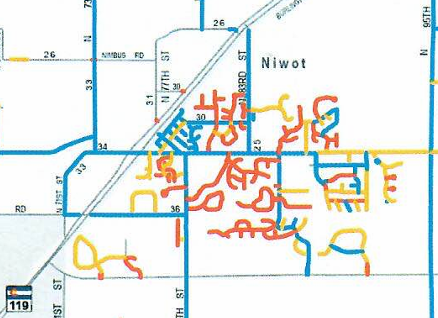
The list below shows the roads the county has repaired since 2015, as provided by Dan DeLange, Boulder County Public Works, in August 2025. Rows in green remain on the county’s repair list; rows in red have been dropped. Some downtown roads (1st, 3rd, 4th, 5th) and Gold Nugget (a special project to fix a water line under the road) are still “blue,” but they are not on the county’s repair list and will eventually degrade with no owner.
| Road | Approx. Year | Treatment |
|---|---|---|
| 79th | 2022 | Overlay |
| Monarch | 2022 | Overlay |
| Niwot | 2019 | Overlay |
| 2nd | 2023 | Overlay |
| 83rd | 2017 | Reconstruct |
| Neva | 2019 | Reconstruct |
| Longview | 2015 | Overlay |
| Somerset | — | Chip |
| 95th | 2020 | Overlay |
| Morton | 2020 | Overlay |
| Walker | 2020 | Overlay |
| Paiute | 2020 | Overlay |
| Marathon | 2020 | Overlay |
| Burgundy | 2020 | Reconstruct (PID) |
Green = remains on county repair list. Red = removed from list.
Niwot’s 31.4 miles of road break down as follows. Nearly three-quarters has no funded repair plan.
The 23 miles in the “No One Repairs” category average a PCI of 44. As the comparison table below shows, that is well below every comparable Colorado municipality — including towns smaller than Niwot. Chip and slurry sealing can extend the life of roads with PCI > 50, but they do nothing for roads below 50. Roads with PCI < 25 need to be reconstructed; PCI 25–50 needs mill and overlay. (Boulder County’s PID cost model assumes all roads with PCI < 50 need full reconstruction, which raises the initial project cost.) Burgundy Park’s PCI was approximately 44 prior to its PID reconstruction; the only other PID neighborhood, Homestead, has a PCI between 15 and 24.
| City / Town | Approx. Population | Avg. PCI |
|---|---|---|
| Golden | 20,000 | 84 |
| Lakewood | 156,000 | 83 |
| Denver | 710,000 | 80 |
| Erie | 30,000 | 78 |
| Broomfield | 75,000 | 75 |
| Fort Collins | 170,000 | 74 |
| Loveland | 80,000 | 74 |
| Thornton | 145,000 | 73 |
| Longmont | 100,000 | 71 |
| Firestone | 15,000 | 71 |
| Louisville | 21,000 | 67 |
| Durango | 20,000 | 67 |
| Wheat Ridge | 32,000 | 66 |
| Littleton | 46,000 | 63 |
| Pueblo | 112,000 | 62 |
| Niwot | 4,306 | 44 |
The distribution of Niwot’s road miles by PCI bucket makes the problem visible. A typical Colorado town — Firestone, for example — has most of its road miles clustered in the 60–90 range with very little under 50. Niwot has roughly a third of its mileage below PCI 30 and only about one mile in six above PCI 80.
The road repair and maintenance costs in the pro forma budget seem too low to be believable.
The costs are based on industry standards and actual bids from qualified contractors. In addition to the basic per-square-foot repair cost, typical and expected “burdens” or “uplifts” for a construction project of this size and scope are included.
The pro forma budget includes three separate road-related line items:
- An initial major capital project to bring all public roads in Niwot up to good condition (PCI > 70) and to address related transportation infrastructure — road repair and reconstruction, with a contingency allowance of about $1.1 million carried for bridges, drainage, sidewalks and similar assets, to be scoped in the engineering phase. Total cost in 2026 of ~$11 million, assumed to inflate to ~$12 million by 2029 plus the cost of any further degradation. The project is funded by a voter-approved bond of up to $15 million in 2029. Annual repayment cost in the first full year (2030) = $1.235 million assuming the full $15 million is issued.
- Ongoing maintenance, including reserves for future road projects — ~$1.28 million (2030), rising with inflation. Rather than a flat percentage, the model runs a full pavement-lifecycle calculation for every road segment — crack sealing, mill & overlay, and reconstruction/FDR on a roughly 26-year cycle for local and residential-collector roads and a 21-year cycle for arterial collectors — and folds in the reserve contribution for the next major repair cycle. Roads are by far the town’s largest asset, so this builds the reserves needed to avoid repeating decades of deferred maintenance.
- Snow removal and street sweeping across all roads — ~$0.12 million, modeled separately to reflect seasonal variability.
- Signs, lights, striping, and related road operations — ~$0.06 million. With every element included, the total annual commitment to roads in 2030 is approximately $2.7 million.
With bond repayment, ongoing maintenance (including reserves for future road capital projects), snow removal, and related operations, the total committed to roads in 2030 is approximately $2.7 million. The charts below show the broad revenue and expense categories in 2030.
Contractors that provided estimates
- Son-Haul, Inc., Fort Morgan CO — most recent bid; see appendix.
- Enright Asphalt, Denver CO
- Blacktop Plus, Denver CO
How does this compare to what similar towns actually spend? Shouldn’t we just look at Elizabeth or Lyons?
The suggestion comes up often: rather than build a bottom-up cost model, why not use the road budget of a comparable Colorado town as a benchmark for what Niwot should expect to spend?
Comparing municipalities is a rough surrogate and an inferior methodology when you have actual cost data — and Niwot does. The town’s road numbers are built from Boulder County’s own 2025 PID cost model and independent contractor bids (see the Son-Haul base bid appendix). Any proxy town differs in ways that materially move the number:
- Growth rate. Elizabeth is one of the fastest-growing towns in Colorado; Niwot’s population is close to stable. Growing towns budget for new capacity, not just maintenance.
- Special projects. Elizabeth is currently reimagining its entire main street to support a much larger future population. That capital cost falls in the roads budget but is not a scenario Niwot faces.
- Capital vs. cash accounting. Elizabeth spends primarily using current-period cash on road projects; Niwot’s plan capitalizes the initial rehabilitation via a bond. Comparing annual line items pretends these methods produce equivalent numbers — they don’t.
- Grant and CDOT windfalls. Elizabeth received several hundred thousand dollars in CDOT and grant funding for capital improvements in the past year, which strongly influences the reported spend and won’t recur every year.
- Road condition. Repair needs vary widely between municipalities. A town starting from PCI 75 has a very different budget than one starting from PCI 44.
What the numbers actually show
Given those “apples to oranges” issues, the town-specific cost model is the primary reference. That said, after adjusting for capitalization, maintenance vs. improvement, and inflation, the topline comparison lands close to Niwot’s number:
| Municipality | Road Spend (2030-adjusted) | Miles | Per Mile |
|---|---|---|---|
| Elizabeth | $840,000 | 11.9 | $70,600 |
| Lyons | $911,000 | 11.4 | $79,900 |
| Niwot (planned) | — | — | ~$80,000 |
Elizabeth: most recent fiscal year inflated to 2030. Lyons: 2025 budget of $486,000 for roads plus $300,000 of capital projects (assumed all deferred maintenance for comparability), inflated to 2030. Niwot: 2030 pro forma budget after adjustments discussed with the NCA road committee.
Three independently derived numbers converge within about 12% of each other. That is a useful cross-check on the pro forma — but it is a cross-check, not a substitute for the underlying cost model.
Why not lean harder on the benchmark?
The convergence is real, but so is the risk of cherry-picking. One could survey hundreds of Colorado municipalities and find budgets substantially below or above Niwot’s projection — often driven by exactly the differences listed above. It is equally possible to make different adjustments to Elizabeth or Lyons, or to use 20-year budget-averaging techniques, that would produce a divergence rather than a match. That is precisely why the town’s road budget rests on a cost model specific to Niwot — built from the many known inputs available to us — rather than a comparative shortcut.
The 2025 community-wide PID worked off a $53M estimate for road rehabilitation over 25 years. How does that reconcile with the incorporation estimates?
Any PID would be governed by Boulder County and must use the County’s cost numbers, which are intentionally conservative so that the PID fully covers unexpected costs. The two costs that matter most are the initial project cost and the annual tax. Per the Boulder County Subdivision Paving PID page, the pavement-management plan is essentially the same as the town plan, except that the County assumes full depth reconstruction at PCI < 50 when setting the mill levy. Its cost per mile is deliberately conservative and does not change with the reconstruction method eventually bid. Any particular PID would be sized from a more detailed analysis of that area.
- Reconstruction (initial project cost)
- Mill and overlay approximately every 20 years
- Chip seal work approximately every 7 years
Unlike the town pro forma — which separates road bond repayment and annual maintenance — all of the costs in a PID are covered by a single property-tax mill levy. The mill levy must cover the cost of financing as well as construction, since the county will no longer provide funds to a PID.
Because state law limits a PID bond term to 20 years (the same term assumed for the incorporation road bond), the right comparison is 20 years, not 25.
PID model
- 2025 PID expected revenue at 12 mills = $2.26 million/yr, of which 95% ($2.15 million) would go to roads (the other 5% to the Niwot Master Plan).
- Initial project cost in 2025: ~$25 million.
- Estimated cost inflated to 2029 at 3%: ~$28 million (potentially higher with continued degradation).
- Total financing cost for a 20-year bond of $28 million at 4.62%: ~$19.5 million.
- Total revenue required over 20 years: $47.5 million for roads.
- Annual cost for a $28 million project: $2.3 million.
Why was the PID talking about 25 years instead of 20? Boulder County Public Works calculated the 2025 levy from total costs “spread over a 25-30 year life cycle.” A district has to borrow and repay within twenty years, which takes the same roads from 12 to about 17 mills, and two more years of wear take them to 18 (how 12 becomes 18).
Both sides of this comparison are financed at the same 4.62% (see Sizing the issue for why that rate carries a February 2026 date). A higher rate in 2029 raises the cost of a PID bond and a town bond alike, so it does not move the comparison between them — but only the town bond carries a voter-fixed ceiling on total repayment.
Town model
The town model is an initial project cost in 2026 of $11 million, inflated to $12 million in 2029 on construction inflation alone; the $15 million bond authorization adds expected degradation and bid contingency (how the three figures relate). It results in an annual cost of $1.235 million for bond repayment plus ~$1.28 million for ongoing maintenance (including reserves for future road capital projects) and ~$0.18 million for snow removal, street sweeping, and related infrastructure — approximately $2.7 million/year committed to roads.
How long will it take to actually fix the roads? Will it become a fight between neighborhoods over which roads get done first?
Because the Town Model uses Full Depth Reclamation (FDR), the time required to complete the entire initial project is measured in months, not years.
Assuming voters approve the road bond on the November 2026 ballot:
- August 2027
- Town officials are installed.
- During 2028
- Road project is engineered, logistics are planned, bids are solicited, the total amount of road bonds to issue is decided (not necessarily the full $15 million), bond issue is prepared.
- April 2029
- Road bonds issued based on sales tax revenue in 2028.
- Summer 2029
- Project begins.
- End of 2030
- Project completed.
Planning the project in 2028 means it is ready to go as soon as the funds are available in 2029, avoiding competition over which roads get done first. Every road gets repaired in the same program.
Timing matters. The longer the community waits, the higher the cost — and not only because of inflation. Road condition declines faster after PCI drops below 60. Waiting until PCI drops below 50 more than quadruples the cost by moving from slurry seal ($0.54/sf) to M&O ($2.44/sf). Waiting until PCI drops below 25 more than doubles the cost again by moving to FDR ($5.67/sf).
How does the bond actually work — what limits how much can be issued, and what oversight applies?
The instrument
Ballot Issue 306 authorizes revenue bonds payable from the town’s sales and use tax, with the proceeds designated a voter-approved revenue change under Article X, Section 20 of the Colorado Constitution. These are not general obligation bonds. No property tax is pledged to their repayment, and no lien attaches to any property in the town.
Two ceilings, both on the ballot
Ballot Issue 306 caps the borrowing at $15 million in principal and $28 million in aggregate repayment cost — principal and interest combined. Both limits are fixed by the voters, not chosen later by a council.
Sizing the issue
The pro forma models a 20-year term at 4.62% — the February 2026 Piper Sandler scenario, which was market rates at that time plus 50 bps. Issuing the full $15 million produces annual debt service of $1.235 million.
That is a modeling assumption with a date on it, and the date has moved. In a September 17, 2026 memorandum, the same firm puts current pricing for a comparable municipal issue at 4.75% to 5.75%, following the Federal Reserve’s rate increase on September 16. We have left the pro forma at 4.62% rather than re-model to a rate that will itself be two and a half years stale by the April 2029 issuance, and we are naming the gap here instead of quietly closing it.
What absorbs that gap is not the forecast. It is the second ceiling on the ballot. The $28 million aggregate repayment cap is fixed by voters in 2026 and binds whatever rates do in 2029: at a higher rate, the principal that still fits beneath it is smaller, so the town issues less and scales the program to the money available. No rate increase reaches a resident’s tax bill, because under TABOR no rate can be raised to service the debt without another vote. The memorandum adds one point in the town’s favor on this: the bonds are expected to carry a 10-year prepayment provision, which lets a future council refinance into a lower rate after 2039 if the market allows.
Three figures appear in this paper and they measure three different things:
- ~$11 million
- The scope of work priced in 2026 dollars, built from Boulder County’s 2025 PID cost model and the Son-Haul bid.
- ~$12 million
- That same scope carried to 2029 on construction inflation alone. It deliberately excludes the pavement degradation that occurs between 2026 and 2029 — miles that slip below PCI 50, or below 25, move into more expensive treatment categories.
- ~$15 million
- The all-in 2029 figure: the inflated scope plus expected degradation plus bid contingency. This is why the bond authorization is $15 million and why the cost-of-waiting timeline begins there rather than at $12 million.
The same degradation mechanism that separates $12 million from $15 million is what carries the estimate to ~$22 million by 2034 and ~$33 million by 2040. Deferral is not simply inflation; it moves miles into treatment categories that cost three to four times as much per square foot.
The council is not obligated to issue the full $15 million. If bids in 2028 come in below the model, it can issue less, and authority not used in 2029 can be issued in later years.
Bond size is ultimately set by the revenue available to repay it. Underwriters require pledged revenue to exceed annual debt service by a comfortable margin, so the sales and use tax Niwot actually collects in 2028 — not a projection — governs the 2029 issuance. A town that collects less issues less.
What the law requires after issuance
Accountability for bond spending is not a campaign promise. It is a set of standing statutory obligations:
- An annual independent audit. Colorado’s Local Government Audit Law (C.R.S. 29-1-603) requires the governing body of every local government to cause an annual audit of its financial statements by an outside CPA, filed with the Office of the State Auditor. Exemptions are available only to governments at or below $1 million in revenue and expenditure (as updated by SB 25-023); Niwot’s projected budget exceeds that threshold from Year 1, so no exemption is available.
- A public budget, adopted on the record every year through a statutory process.
- TABOR notice and reporting obligations attaching to the voter-approved revenue change.
- The bond covenants themselves, which give bondholders a contractual and enforceable claim on how pledged revenue is handled.
A future council could go further — a citizen oversight committee, a public spending dashboard — and many Colorado towns do. Those are choices for a council the community elects, not commitments this committee can make on its behalf.
Default risk
The Colorado bond defaults that reach the news are almost always special districts — most often metropolitan districts formed to finance new subdivisions, which borrow against development that has not been built yet. They are legally classified as municipal bonds, which is the source of most confusion on this point, but a metropolitan district is not a city or a town. Colorado’s general-purpose municipalities have an essentially spotless record repaying bond debt; Piper Sandler’s September 2026 memorandum puts it as default by an incorporated Colorado municipality being “extremely rare.” We use that wording rather than a stronger one because it is the wording the underwriter will put its name to.
The memorandum is also specific about what a bondholder could reach if it happened: only the pledged sales and use tax. Investors would have no claim on the town’s other property or on any individual’s assets, and neither property tax nor marijuana tax revenue is pledged to repayment.
The full comparison — why a metro district’s risk profile differs from a town’s, and what structurally protects residents here — is set out in the FAQ: Is issuing bonds risky for Niwot residents?
Why can’t individual neighborhoods just fix their own roads?
Niwot has 18 HOAs and 10 non-HOA neighborhoods with failing roads owned by Boulder County. (This does not include the 10 HOAs with private roads that were never accepted for maintenance by the county.) Two ideas come up for how these 28 neighborhoods could “fix their own roads”: (1) have the HOA do it, or (2) a neighborhood PID.
Have the HOA do it — but HOAs aren’t allowed to
A common misconception is that HOAs can fix county-owned roads. There appears to be a loophole in county regulations that might allow an HOA to repair the roads, but discussions with the county show that any HOA doing so would take on full liability for the roads in perpetuity, and would risk the county objecting to the outcome. County paperwork and conversations with the Transportation Department confirmed this. The engineer explained that the county could declare the work was not up to county standards and require the HOA to redo it. Liability for any accident attributable to road condition would also fall on the HOA.
Second, the Colorado Common Interest Ownership Act (CCIOA, Title 38 C.R.S.) limits the use of HOA funds to common elements. A road dedicated to the county is not a common element, so the HOA cannot be the funding mechanism. A pre-1992 HOA not subject to every part of CCIOA might be able to work around this, but only if its Declaration of Covenants permits assessments to be spent on public property.
A neighborhood PID — small-scale, expensive
A local PID is the only available option for a neighborhood that wants to go it alone. Boulder County has set up the mechanism and will help with the process — details are on the Subdivision Paving PID page. Burgundy Park took this path in 2017. It is the only successfully established PID referenced on the county website, although the county notes that “several other subdivisions are currently working towards forming their own PIDs.” Homestead in Gunbarrel began the process in 2022, formed the PID in 2024, and received bids in 2026. For both neighborhoods, the county offered to pay 30% of the initial project cost and fund the work with an interest-free loan.
The county no longer offers to pay any part of the initial project work and will only help secure funding via loan, bond, or similar instrument. Interest costs are then paid by the PID, adding roughly 70% to the property tax required. The alternative is for the PID to collect funds until enough cash is on hand to start the work — delaying repairs by 8–10 years (and increasing the cost in the meantime).
Forming a neighborhood PID is not impossible, but it requires substantial effort and a dedicated group of volunteers. The county chart below shows the steps involved; the time from initiation to road work is often measured in years. Costs for smaller-scale projects are high. Burgundy Park’s initial mill levy was 16.597 mills, later temporarily reduced to 12.25 mills after property valuations rose; Homestead’s mill levy is 23.61 mills. Both benefited from a 30% county contribution and an interest-free county loan — contributions the county no longer offers. Modeling Homestead’s project without those contributions puts the mill levy at approximately 32 mills, roughly doubling the average household cost compared with a community-wide PID.
A separate problem with neighborhood PIDs is the question of who fixes roads that serve more than one neighborhood — Meadowdale Dr, Dry Creek Rd, Longview Dr, Somerset Dr. The closest neighborhood? The one with the most houses? Even if several subdivisions go the PID route, it does not solve Niwot’s community-roads problem.
| Step | Due Date | Task | Responsible Party |
|---|---|---|---|
| 1 | February | Subdivision provides letter to Public Works expressing interest in forming a PID | Owners/HOA |
| 2 | — | Identify proponents (minimum recommended: three) | Owners/HOA |
| 3 | — | Identify proposed district boundary | Owners/HOA |
| 4 | — | Identify proposed district improvements/projects | Owners/HOA |
| 5 | — | Estimate costs (either annual or whole project) | Public Works (PW) |
| 6 | — | Estimate mill levy based on district boundary and assessed values | PW and GIS Staff |
| 7 | March | Develop petition with information from steps 2 to 6 | PW and County Attorney |
| 8 | — | Verify petition meets minimum statutory requirements | County Attorney’s Office |
| 9 | — | Collect signatures | PID Proponents |
| 10 | Early June | Submit petitions | PID Proponents |
| 11 | July | Schedule BOCC hearing (20–40 days after submission) | County Staff |
| 12 | — | Clerk publishes notice and sends to all electors and municipalities within 3 miles | Clerk |
| 13 | — | Board adopts resolution establishing the District | BOCC |
| 14 | August | Certify ballot language | County Clerk and Recorder |
| 15 | November | Hold election | County Clerk and Recorder |
| If the election is successful | |||
| 16 | Dec/Jan | Develop and sign intergovernmental agreement with Boulder County (if necessary) | PID and BOCC |
| 17 | Feb/Mar | Develop project scope, plan specifications, and estimates | Public Works |
| 18 | Apr/May | Secure funding via loan, bond, or other instrument (if necessary) | PID (County) Finance Staff |
Individual PIDs sound like a lot of work at high mill levies. Why isn’t a revised version of the community-wide PID that was withdrawn in 2025 an option?
The 2025 PID proposal was researched with Boulder County and qualified for the November 2025 ballot through the work of a dedicated group of volunteers. Once on the ballot, the proposal drew opposition from several places — most notably HOAs with private roads, residents on roads the county has maintained at least somewhat in recent years, and Burgundy Park residents who already have a PID. Based on the input, surveys, and objection letters from attorneys, the organizers withdrew the petition. Home Rule incorporation emerged as a more comprehensive solution at an overall lower cost for roads. The PID volunteers are now part of the incorporation effort, and no revised townwide PID is on offer: no proposal exists and nobody is assembling one.
A revised district would not be cheap, because a townwide levy is affordable only while everyone stays in. On today’s figures it needs 18 mills with every property inside the boundary paying. Draw out those a district would tax for roads it never touches or roads they already pay for — the eight neighborhoods on private roads, the homes on county roads, Burgundy Park, and the business parks, which can form a district for their own parkways — and it is about 27 mills on everyone left. At 27, five neighborhoods would pay less with a district of their own, and it settles near 31: $2,160 a year on the median home, about three times incorporation’s $752, for pavement only. The full derivation.
The diagrams below are the 2025 analysis, kept as the record: the community-wide proposal, and the first alternative the organizers looked at, which drew out only the private-road and Burgundy Park properties. Both are in 2025 dollars on the 2025 proposal’s 25-year cost basis, which is why their levies are lower than today’s 20-year figures above.


Red areas are included in the PID property tax; green areas are excluded. Essentially all of the road work is for the 73% of roads in the “No One Repairs” category, so the construction cost is the same in either scenario.
Don’t residents on private roads, county-maintained roads, and in Burgundy Park have a point? Why should they have to pay for a community-wide solution — Town or PID?
Roads are a community asset that a properly functioning municipality pays for. Because Boulder County abandoned most of the roads and refused to accept maintenance responsibility for others, neighborhoods and HOAs have reasonably had to act in their own interest. The roads still have to be paid for one way or another, but the considerations differ by neighborhood type.
Private roads — good condition
Ten HOAs own the roads in their subdivisions. For most of these HOAs, the roads appear to be in relatively good condition, though PCI ratings are not available and recent work may have been limited to slurry coating. The HOA currently collects assessments for repairs, maintenance, and snow removal. Our budgeting is based on the expectation that an agreement will be made between HOAs with private roads and the Town of Niwot such that responsibility for repairs, maintenance, and snow removal is transferred to the town. Under such an agreement, the roads would be removed from the HOAs’ reserve-study liability, and assessments lowered accordingly. The specific legal vehicle (mutual dedication, a perpetual public-access easement with a maintenance agreement, or similar) can be tailored to each HOA — the substance is the same in each case.
Private roads — fair condition
Countryside and Cottonwood Condominiums HOAs share Countryside Dr, and Countryside HOA is responsible for Countryside Park and Countryside Lane. Countryside HOA’s 2021 reserve study by Aspen Reserve Specialties (ASR) indicates that crack fill and pothole maintenance should be an annual operating expense, that asphalt should be seal-coated every 3–4 years, and that the roads will need mill & overlay in approximately 2037. ASR estimated an M&O cost of $1.65–$1.90/sf in 2021, which inflates to roughly $2/sf plus overhead today — consistent with current estimates.
The reserve study combines roads and parking lots. The roads alone total about 72,000 sf between the two HOAs. At an expected cost of $2.44/sf with overhead, an M&O project runs ~$176,000 across 260 units, or about $680/unit. According to the property manager, road projects are funded as needed with minor repairs and seal coating; no funds are being set aside for the eventual M&O project.
The HOA financials include annual snow removal expenses, presumably for both roads and parking lots. Some property owners argue that since their HOA doesn’t collect dedicated road assessments, there would be no “savings” in transferring roads to the town. That view overlooks the eventual $680/unit M&O liability and the ongoing snow-removal cost. Roads are paid for one way or the other, and the cost doubles if the HOA waits until the roads need full reconstruction.
The town’s proposed 4 mills property tax on an average-value condominium in these HOAs is about $90/yr. The proposed sales tax (assuming $12,800 in purchases per person and single occupancy) is about $320/yr. The town plans to take on maintenance, snow removal, and the eventual M&O project for these roads — offsetting the $830/unit liability and ongoing snow-removal cost the HOAs would otherwise carry.
Every association that owns roads is priced separately. niwot.town/private-roads sets out what would and would not change, what each association’s roads are likely to cost per home at overlay and at full rebuild, and three questions worth asking a board. The condition scores behind the private-road figures are assumed rather than surveyed, and that page says so and asks associations to send us a reserve study we can publish instead.
County-maintained roads
Some properties are on roads that the county has repaired in the past 10 years (Somerset, parts of Longview, Morton, Walker, Paiute, Marathon). Others are on roads worked on more than 10 years ago but still in good shape (Murray, 1st, 3rd, 4th, 5th, Gold Nugget). These roads will need annual maintenance and future repairs that the county may no longer provide. A few residential properties and many commercial properties are on roads that will be part of an intergovernmental agreement between the county and the town — streets in many Boulder County municipalities that pass through the municipality are still maintained by the county.
Burgundy Park PID
Burgundy Park passed a PID in 2017 at 16.597 mills. The county paid 30% of the initial project cost and funded the road reconstruction with an interest-free loan repaid from the PID. For taxes paid in 2025, the county commissioners stated:
The county loan will be fully repaid in 2026 or 2027. Upon incorporation, and assuming the debt is fully repaid (by the PID or the town), management of the PID transfers to the town council.
By mutual agreement of the potential Town Council and the Burgundy Park property owners, the PID could be dissolved and all road repair costs transferred to the town, removing the current 12.250 mill levy for these owners.
Some in Burgundy Park have suggested the town should reimburse them for PID taxes already paid. Those funds have been spent. The only mechanism in Colorado law for reduced property-tax areas within a municipality applies to economically distressed areas. The town council and Burgundy Park owners could consider creative options, such as keeping the PID in place at a very low tax rate so it receives special treatment on future road projects.
I’m opposed to any new taxes. As long as I can drive on the roads, I’d rather do nothing — it doesn’t really affect me.
Some costs hold a community together, and community roads are one of them. If you never plan to sell, lower taxes may beat higher property value — a reasonable preference. For most owners, though, your home is the largest asset you’ll eventually sell, and road condition affects what it sells for.
Key considerations
The absence of a funding source for road repair can be a material adverse fact when selling a home. A seller’s failure to disclose a known adverse material fact affecting the property can create legal liability. Homes adjacent to county roads must disclose this on the Colorado Seller’s Property Disclosure form. Road disrepair (especially if it impacts access) and the absence of any maintenance or repair plan would typically qualify for disclosure in the “Other Known Adverse Material Facts” section — the section that requires disclosure of any known adverse fact affecting the property even if it’s not specifically listed. If a seller has specific knowledge (for example, the county’s 2025 notices that no repairs are planned without a PID) that a reasonable buyer wouldn’t discover through ordinary inspection, it must be disclosed. Visible potholes are usually considered “patent” (obvious), but the absence of a repair plan is not obvious and can be material.
Poor roads cause vehicle wear and increase accident risk — both direct costs you pay.
Road condition matters to property values. Roads in disrepair raise annual vehicle operating costs — the ASCE Infrastructure Report Card estimates over $1,400 per driver per year. Deteriorated roads are also linked to elevated accident risk and slower emergency response, both of which influence buyer perception. Empirical studies consistently show a positive correlation between road quality and home prices: homes on streets rated “good” command higher prices than those on streets rated “poor.” Visible infrastructure decay signals public neglect and discourages new residents and investment.
Deferred maintenance also compounds. As roads deteriorate, the investment required to restore them grows non-linearly. Homebuyers price that risk in, which leads to lower offers and slower sales cycles in areas with visibly poor roads.
References
- ASCE Infrastructure Report Card — Roads (poor roads cost U.S. drivers ~$1,400/year)
- Pew Charitable Trusts — State Road Funding Gaps (2025)
- Rural Economic Impact — Road Deterioration and Property Values
What is FDR? Is it an acceptable way to fix our roads? I’ve heard the incorporation plan is a “cheap” way of fixing the roads.
FDR is full-depth reclamation. Instead of digging out and hauling away failed road base, the existing pavement and base are ground up in place and mixed with concrete and other additives to create a uniform subbase. FDR is increasingly used in Colorado for both municipal streets and state highways. It recycles existing asphalt and base layers into a strong foundation for new pavement, significantly reducing material transport and disposal costs. Cities and towns across Colorado — from Meeker to Denver and Centennial (work done by Son-Haul, who has provided Niwot’s attached bid) — use this method for road reconstruction projects. FDR has also been used in Longmont, Fort Collins, Weld County, Greeley, Breckenridge, Fort Morgan, and by CDOT (CO Hwy 13 south of Meeker).
Case studies report 35–40% cost savings and substantial CO2 emissions reductions compared to traditional remove-and-replace (R&R). FDR also reduces sensitivity to oil-price volatility.
See the May 5, 2025 article by Scott Sounart, PE (Broomfield, Colorado): Full-Depth Reclamation: Sustainable Asset Management (Kimley-Horn).
Advantages over traditional methods
Structural restoration. Unlike overlays that mask surface-level issues, FDR addresses deep structural failures (base degradation, alligator cracking) by rebuilding from the pavement foundation up.
Cost efficiency. FDR reduces material hauling, eliminates import/export of aggregate, and uses equipment efficiently. Lifecycle costs are generally lower than full R&R when full-depth problems exist.
Time savings. FDR compresses construction time; projects that take weeks with R&R are often completed in days, reducing traffic-control costs and disruption.
Sustainability. Nearly 100% of the material is reused in place, minimizing landfill use, hauling emissions, and carbon footprint.
For roads with structurally sound bases, overlays suffice at lower cost than FDR. The town model uses FDR for roads with PCI < 25, M&O for PCI 25–50, crack sealing and seal coat for PCI 50–70, and minor crack sealing for PCI > 70.
Consensus from current literature
Sources highlight FDR as best practice for reconstructing roads with failed structural layers. The National Cooperative Highway Research Program (NCHRP) synthesizes DOT practices showing FDR adoption as standard for in-place recycling when the subgrade is stable but asphalt and base layers have failed. Modern engineering standards prioritize FDR for cost, time, and environmental efficiency. FDR is widely regarded as a current leader in sustainable, cost-effective, and rapid road rehabilitation for pavements with deep distress.
If the incorporation vote fails, what happens to the roads?
The roads still need repair. That doesn’t change. What changes is whether there is a community-wide solution on the table.
The volunteers who built the 2025 community-wide PID proposal are now part of the incorporation effort. The county’s public position has not moved: 23 miles will not be repaired by Boulder County. There is no other coordinated, community-wide effort underway.
Three consequences follow:
- Neighborhood-by-neighborhood becomes the only path. A patchwork of individual PIDs at 14–47 mills, typically 33 — about three times what incorporation costs a typical home — each requiring its own volunteer organizers, signature drive, county process, and election. Only two neighborhood PIDs have ever completed the process in unincorporated Boulder County — Burgundy Park (2017) and Homestead (2024).
- Shared roads have no owner. The residential collectors that serve multiple neighborhoods — Meadowdale Dr, Dry Creek Rd, Longview Dr, Somerset Dr — aren’t fixed by anyone’s neighborhood PID. They keep degrading.
- The cost rises every year. Roads below PCI 50 need mill & overlay ($2.44/sf); below PCI 25 they need full reconstruction ($5.67/sf). Whatever the eventual repair cost is, it is lowest today.
A “no” vote is not a vote for the status quo. The status quo is already eroding. It is a vote to handle the roads neighborhood-by-neighborhood, at higher cost, on a longer timeline, with no owner for the roads that connect us.
Roads Are One Part of a Bigger Decision
Roads are the most visible problem, but they are not the only one. For about a third of what a road district would cost a typical home for roads alone, incorporation also gives Niwot control of its own land use, protection from county wage policy, and a seat at the regional table on every decision that affects the community — from Xcel franchise terms to bike-path alignments to how state housing requirements land near the CO 119 transit corridor.
A road district — for your neighborhood, or a townwide one if anyone ever assembled it — costs a typical home 31 to 33 mills, $2,160 to $2,300 a year, for pavement only. Incorporation fixes the same roads for $752 — 4 mills of property tax plus a 2.5% sales tax that visitors and commercial traffic also help pay — and plows them, sweeps them, and addresses every other structural gap left by being unincorporated.
A third of the cost of a road district.
Same roads — and a voice in everything else.
Take the next step
See your actual cost · Read the FAQ · Talk to a neighbor · Sign the petition
Appendix A — Son-Haul Base Bid
Below is the most recent contractor bid received from Son-Haul, Inc. (Fort Morgan, CO), with adjustments and uplifts applied to produce the project total.
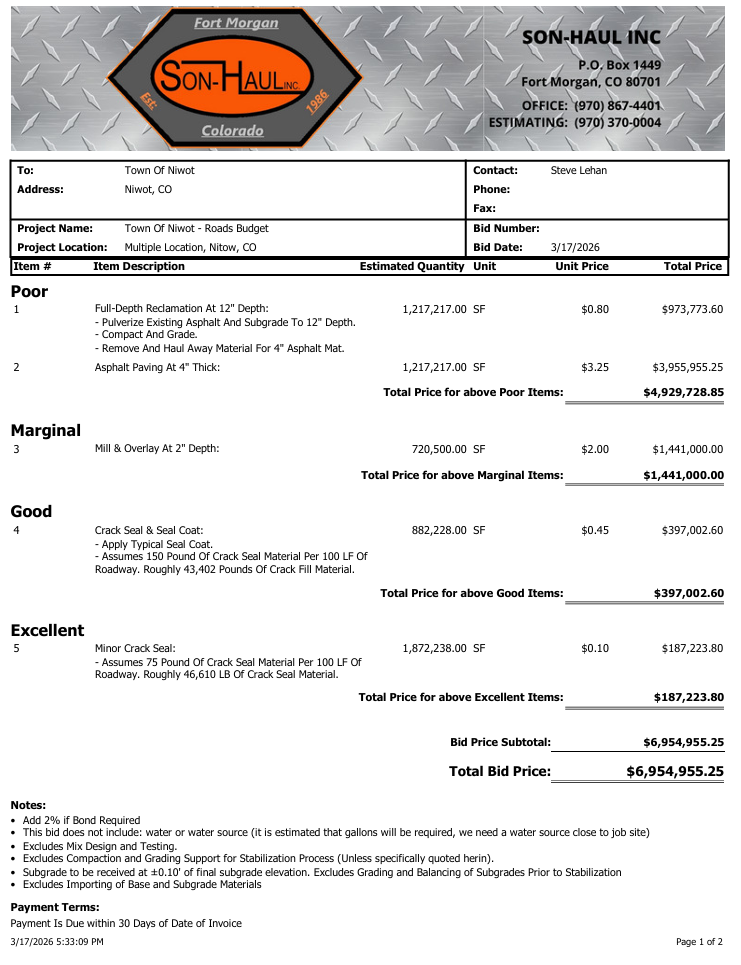
| Line Item | Description | Amount | Notes |
|---|---|---|---|
| Son-Haul Base Bid | All pavement treatments (FDR on poor roads, mill & overlay, seal coats, crack sealing) | $6,954,955 | Bid total as submitted |
| Performance / Payment Bond | 2% of base bid (required on most public projects) | $139,099 | Explicitly noted in Son-Haul bid; standard for municipal work |
| Mobilization | Contractor setup, demobilization, equipment transport | $347,748 | 5% of base (typical range 4–8% for mid-size paving jobs in CO) |
| Traffic Control | Flagging, signs, barricades, management during work | $243,423 | 3.5% of base (CDOT pay estimates show $1,000–$1,400/day; multi-road project) |
| Erosion Control / SWMP | Silt fence, seeding, stormwater management plan | $69,550 | 1% of base (required by CDPHE/CDOT for any earth disturbance) |
| Mix Design & Testing | Lab mix design, compaction testing, material verification (especially FDR) | $175,000 | Excluded in bid; typical $100K–$250K for FDR + asphalt stabilization at this scale |
| Water Source & Usage | Water for FDR mixing/compaction (noted as excluded) | $75,000 | Excluded in bid; FDR can require tens of thousands of gallons |
| Subgrade Grading, Compaction Support & Material Import | Balancing subgrade, additional base import if needed | $450,000 | Exclusion in notes; ~9% on the $4.93M Poor category only |
| Construction Subtotal | Direct contractor work + above adders | $8,454,775 | ~21.5% markup on base bid |
| Engineering / Design / Bid Solicitation | Plans, specs, bidding, permitting | $550,000 | ~8% of construction subtotal (standard municipal soft-cost range) |
| Project Supervision / Inspections / CM | Resident engineer, daily inspection, quality control | $450,000 | ~6.5% of construction subtotal |
| Contingency | Unforeseen conditions, price escalation, change orders | $950,000 | 10% of construction subtotal (typical for multi-site road program) |
| Soft-Cost Subtotal | All non-construction items | $1,950,000 | — |
| PROJECT TOTAL | Full estimated delivered cost | ≈ $10.4 million | Range: $9.8M–$11.0M depending on actual testing/grading needs |
Key footnotes & assumptions
- All percentages are derived from 2024–2025 CDOT cost data books, Colorado municipal paving bids, and FDR guidelines (e.g., Asphalt Recycling & Reclaiming Association).
- Soft costs (15–20% total) are typical for Colorado town/county road programs of this size.
- No curb projects are included. Niwot is almost entirely curbless. Unless structural curb damage occurs, no curb projects are necessary for paving.
Appendix B — How the Cost Model Works
Appendix A shows what a contractor bid to repair Niwot’s roads. The road cost model turns that bid into the figures this paper publishes — $15 million in 2029, $22 million in 2034, $33 million in 2040. It prices all 179 road segments by their condition, lets them decay year by year, and adds contingency and inflation.
The model now has its own page: every segment and its condition by year, the four repair prices, every assumption with the direction it pushes the estimate, and what we found when we audited it.
- Read the road cost model — how the $15M / $22M / $33M figures are built, segment by segment.
- Download the workbook — Excel, 179 road segments, live formulas.